Aluminum Foil Grades for Pharmaceutical and Food Packaging Applications
Aluminum foil is essential for pharmaceutical and food packaging due to its complete barrier properties—blocking moisture, oxygen, light and bacteria better than any plastic film. However, choosing the wrong foil grade or temper can lead to pinholes during forming, poor heat-seal strength or delamination.
This guide covers the four main aluminum foil alloys used in packaging—8079, 8011, 1235 and 8006—explaining which grade to use for blister packs, lidding foil, flexible pouches and other applications.
Why Aluminum Foil for Packaging?
Aluminum foil provides barrier properties that plastic films cannot match. Even at just 6–9 microns thickness, aluminum foil is a complete barrier to moisture, oxygen, light, bacteria and aromas. This makes it essential for protecting sensitive products.
Moisture barrier: Zero moisture transmission, protecting hygroscopic drugs and moisture-sensitive foods
Oxygen barrier: Essential for extending shelf life of oxygen-sensitive products (coffee, snacks, pharmaceuticals)
Light barrier: Blocks UV and visible light that can degrade vitamins, flavors and active pharmaceutical ingredients
Aroma barrier: Prevents flavor and aroma loss from packaged products
Microbial barrier: Impermeable to bacteria and mold when properly sealed
Formability: Can be deep-drawn into blister cavities or formed into complex pouch shapes
Heat-sealable: Bonds to plastic films and coatings under heat and pressure
8079 Aluminum Foil: The Pharmaceutical Standard
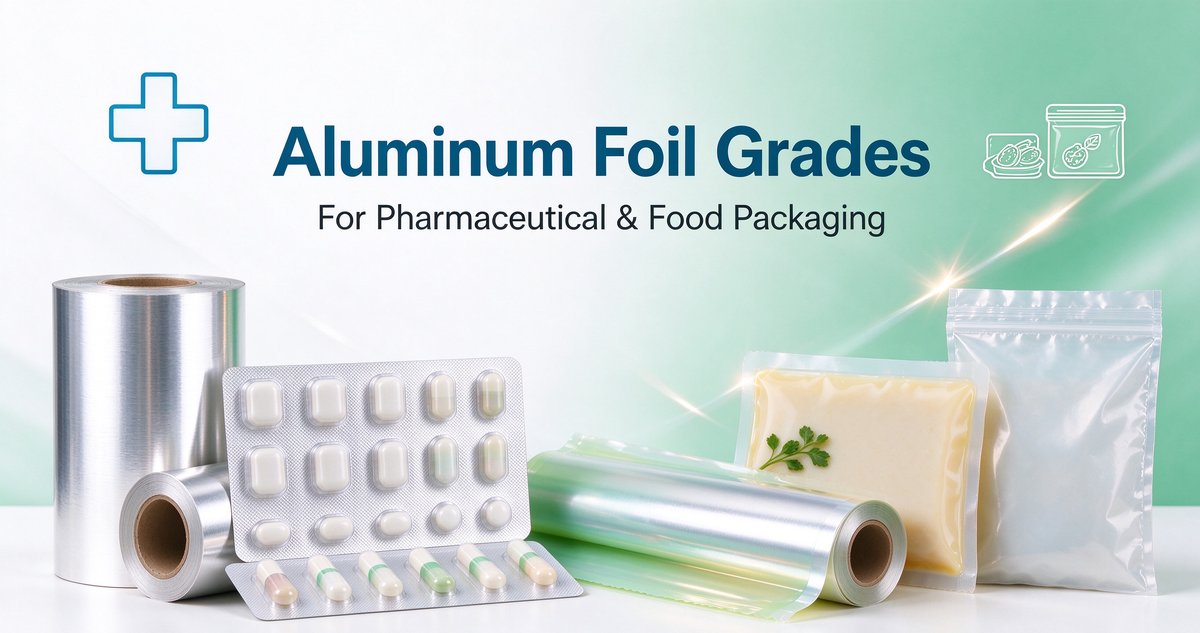
**8079 aluminum foil** is the global standard for pharmaceutical blister packaging. It offers the best combination of deep-draw formability, pinhole resistance and surface quality required for pharmaceutical applications.
8079 contains small additions of iron (0.7–1.3%) which improve strength without sacrificing formability. This allows blister foil to be formed into deep cavities (7–10 mm depth) without tearing or pinholes.
Typical applications: Cold-form blister base foil (hard temper H18), tropical blister lidding (soft temper O or H14), strip pack foil, sachet inner layer.
Blister base foil: 8079-H18 45–60 µm, aluminum-only or aluminum-plastic laminate, deep-draw formability
Lidding foil: 8079-O 20–25 µm, printed and heat-sealed to PVC or PVDC blister
Advantages: Best formability for deep cavities, low pinhole rate, excellent print surface
Typical thickness: 20–60 µm depending on application
Standards: Meets USP Class VI, EP 2.1.17, FDA indirect food contact requirements
8011 Aluminum Foil: Versatile Packaging Alloy
**8011 aluminum foil** is the most widely used foil alloy for general flexible packaging. It is specified for applications requiring good barrier properties and moderate formability at lower cost than 8079.
8011 offers a good balance of strength, formability and cost. It is used for pharmaceutical lidding, food packaging, household foil, lamination foil and semi-rigid containers.
Typical applications: Pharmaceutical lidding foil, yogurt lidding, chocolate wrapping, coffee pouches, lamination foil for aseptic packaging, household foil rolls.
Lidding foil: 8011-H18 30–40 µm, printed and lacquered, heat-sealed to PP or PS containers
Flexible packaging: 8011-O 7–12 µm, laminated with plastic films for barrier pouches
Household foil: 8011-O 10–18 µm, soft temper for easy tearing and wrapping
Advantages: Lower cost than 8079, widely available, good barrier properties
Typical thickness: 7–40 µm depending on application
1235 Aluminum Foil: For Thin Lamination
**1235 aluminum foil** is a high-purity alloy (99.35% minimum aluminum) used for ultra-thin lamination foil in flexible packaging. Its high purity gives excellent formability and a bright, reflective surface.
1235 is specified when the thinnest possible foil is required to minimize cost while maintaining barrier properties. It is used in multi-layer flexible packaging laminates for food, tobacco and pharmaceutical applications.
Typical applications: Flexible packaging laminates (6–9 µm foil), tobacco packaging inner liner, aseptic packaging barrier layer, standup pouches.
Flexible laminates: 1235-O 6.35–9 µm, laminated between plastic films (PET/foil/PE structure)
Aseptic packaging: 1235-O 6.35 µm in Tetra Pak-style cartons for milk and juice
Advantages: Thinnest gauge possible, excellent formability, lowest material cost per m²
Limitations: Too thin for standalone use, must be laminated for strength
Typical thickness: 6.35–12 µm (0.00635–0.012 mm)
8006 Aluminum Foil: For Household and Semi-Rigid Containers
**8006 aluminum foil** is used for household foil rolls, semi-rigid containers (airline meal trays, takeaway containers) and lidding applications. It offers excellent dead-fold properties—the foil stays in place when wrapped or formed.
8006 contains slightly more iron than 8011, giving better stiffness for semi-rigid containers while maintaining formability for wrapping applications.
Typical applications: Household foil rolls, semi-rigid containers, container lids, insulation foil.
Household foil: 8006-O 10–18 µm, soft temper, good dead-fold
Semi-rigid containers: 8006-H22 50–100 µm, formed into trays and containers
Container lids: 8006-H24 30–60 µm, heat-sealed or crimped to containers
Advantages: Excellent dead-fold, good stiffness for semi-rigid applications
Typical thickness: 10–100 µm depending on application
Quick Comparison: Foil Alloys for Packaging
| Alloy | Best For | Typical Thickness | Key Advantage | Typical Temper |
|---|---|---|---|---|
Pharma blister packs | 20–60 µm | Best deep-draw formability | O, H14, H18 | |
General packaging, lidding | 7–40 µm | Versatile, cost-effective | O, H14, H18 | |
Thin flexible laminates | 6.35–12 µm | Thinnest gauge, low cost | O | |
Household foil, containers | 10–100 µm | Excellent dead-fold | O, H22, H24 |
Understanding Foil Tempers
Aluminum foil temper significantly affects its forming and handling properties. The most common tempers for packaging foil are:
Selection rule: Use the softest temper that meets forming and handling requirements. Softer tempers have better barrier properties (fewer microcracks) and are easier to form without pinholes.
O temper (annealed, soft): Fully soft foil with maximum formability. Used for wrapping, deep drawing, thin lamination foil. Easy to tear. Typical for household foil, flexible pouches, blister lidding in soft temper.
H14 (half-hard): Intermediate hardness. Easier to handle than O temper without tearing, but still formable. Used for some lidding applications and moderate-depth blister forming.
H18 (hard): Fully hard foil with maximum strength and stiffness. Used for cold-form blister base foil (deep cavities), lidding foil requiring stiffness, and printed foil that must remain flat. Difficult to tear by hand.
H22, H24 (semi-rigid tempers): Used for semi-rigid containers and trays. Higher stiffness allows self-supporting shapes.
Blister Packaging: Base Foil and Lidding
Pharmaceutical blister packs use two types of aluminum foil: base foil (the formed cavity that holds tablets or capsules) and lidding foil (the printed cover sealed over the cavities).
Cold-form blister base foil: 8079-H18 45–60 µm (aluminum-only) or 25 µm aluminum in aluminum-plastic laminate (e.g. PA/AL/PVC 25/45/60 µm). The foil is deep-drawn into cavities 7–12 mm deep. H18 hard temper is required for formability without tearing. After forming, tablets are filled into cavities and lidding foil is heat-sealed over the top.
Thermoform blister: PVC or PVDC plastic base (not aluminum) with aluminum lidding foil. The lidding is typically 8079-O or 8011-H18 20–25 µm, printed with product information and heat-sealed to the plastic base.
Tropical blister: For hot, humid climates. Uses thicker lidding foil (25–30 µm) or aluminum base foil instead of plastic for better moisture barrier.
All pharmaceutical foil must meet stringent quality standards—pinhole testing (typically <1 pinhole per m² for foil >20 µm), surface cleanliness, and regulatory compliance (USP, EP, FDA).
Flexible Packaging Laminates
Flexible pouches, sachets and standup bags often use multi-layer laminates with a thin aluminum foil barrier layer sandwiched between plastic films. A typical structure is:
PET / Adhesive / Aluminum foil / Adhesive / PE (outer print layer / barrier / inner heat-seal layer)
The aluminum foil is typically **1235-O at 6.35–9 µm or [[foil:8011-O]]** at 7–12 µm. Thinner foil reduces material cost but requires careful lamination to avoid pinholes.
Applications: Coffee pouches, snack food bags, pet food pouches, retort pouches (high-temperature sterilization), pharmaceutical sachets.
The foil provides the barrier properties while the plastic films provide strength, print surface and heat-sealability. Lamination adhesives must be food-safe and maintain bond strength through the product shelf life and any thermal processing (retort, pasteurization).
Quality Requirements for Packaging Foil
Pinhole testing: Pharmaceutical and food foil must pass electrical conductivity pinhole testing. Typical spec: <1 pinhole per m² for foil ≥20 µm, <2 pinholes per m² for 6–20 µm foil.
Surface cleanliness: Oil-free surface for printing and lamination. Typically <30 mg/m² residual rolling oil.
Thickness tolerance: ±5–7% for foil ≥20 µm, ±7–10% for foil <20 µm. Tight tolerance is critical for consistent forming and printing.
Surface quality: No scratches, streaks or oxide spots that would show through printing or cause lamination defects.
Regulatory compliance: FDA 21 CFR 178.3910 for food contact, USP Class VI and EP 2.1.17 for pharmaceutical applications, EN 602 for aluminum foil materials and articles for food contact in Europe.
Conclusion
Selecting the right aluminum foil grade ensures your packaging will provide adequate barrier properties, form without defects and meet regulatory requirements. **8079 aluminum foil is the pharmaceutical industry standard for blister packs due to its superior formability. 8011 aluminum foil is the versatile choice for general packaging, lidding and flexible pouches. 1235 aluminum foil** enables ultra-thin lamination foil for cost-sensitive flexible packaging.
For more technical specifications and thickness recommendations, visit our product pages for 8079 foil, 8011 and 8006 foil, and 1235 foil.