Aluminum Solar Panel Mounting Systems: Complete Installation Guide
Solar panel mounting systems must support panels for 25+ years in harsh outdoor environments—intense UV radiation, temperature cycling from -40°C to +85°C, high winds, rain, snow and in coastal areas, salt spray. The mounting rails are almost always extruded aluminum due to the metal excellent strength-to-weight ratio, corrosion resistance and 25-year lifespan.
This guide covers everything you need to know about aluminum solar mounting systems: which alloys to use, how to size rails for different span lengths, surface finishes for corrosion protection, and installation best practices for rooftop and ground-mount systems.
Why Aluminum for Solar Mounting?
Aluminum has become the universal material for solar mounting structures, replacing steel and wood in almost all modern installations. The reasons are compelling:
Corrosion resistance: Aluminum naturally forms a protective oxide layer that prevents further corrosion, even in coastal and high-humidity environments. No painting or galvanizing required.
Light weight: Aluminum weighs 1/3 as much as steel, reducing roof loads and simplifying handling during installation. A 6-meter rail weighs 3–5 kg vs. 10–15 kg for equivalent steel.
Strength: Aluminum extrusions provide excellent strength in bending and tension. 6063-T6 and 6005-T5 profiles easily span 1.5–2.5 meters between roof attachments.
Extrudability: Complex profiles with integrated channels, slots and wire management features are easily extruded, reducing installation time and hardware.
Lifespan: Aluminum mounting systems routinely last 30+ years outdoors with minimal maintenance, matching or exceeding the panel warranty.
Recyclability: At end-of-life, aluminum rails are 100% recyclable with no loss of properties.
Aluminum Alloys for Solar Mounting: 6063 vs 6005
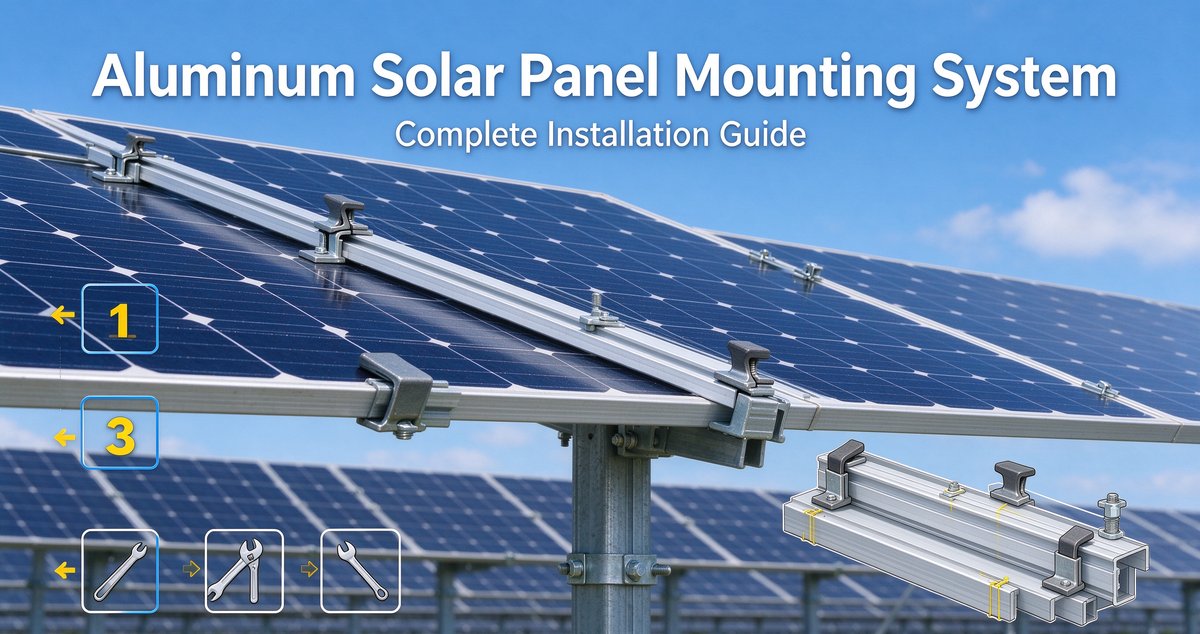
Two aluminum alloys dominate the solar mounting market: 6063 and 6005. Both are heat-treatable Al-Mg-Si alloys with excellent extrudability and corrosion resistance. The choice depends on the required strength and span length.
**6063 aluminum** in T5 or T6 temper is the most common solar mounting alloy worldwide. It offers good strength (205–240 MPa tensile depending on temper), excellent extrudability for complex profiles, and a smooth surface finish ideal for anodizing. 6063-T5 (cooled from extrusion and aged) is used for residential and light commercial systems. 6063-T6 (solution heat treated and aged) provides higher strength for longer spans and higher wind/snow loads.
6005-T5 aluminum is specified when higher strength is required—long-span ground-mount systems, high wind zones, or heavy snow loads. 6005-T5 provides approximately 260 MPa tensile strength, roughly 20% stronger than 6063-T5, allowing longer spans or thinner wall sections. The trade-off is slightly higher cost and less smooth surface finish.
| Property | 6063-T5 | 6063-T6 | 6005-T5 |
|---|---|---|---|
Tensile Strength | 185–205 MPa | 215–240 MPa | 260 MPa |
Typical Applications | Residential rooftop | Commercial rooftop, ground-mount | Long-span ground-mount, high-load |
Span Capability (typical) | 1.2–1.8 m | 1.5–2.2 m | 2.0–2.8 m |
Surface Finish | Excellent (smooth) | Excellent (smooth) | Good |
Cost (relative) | Low | Medium | Medium-High |
Solar Rail Profile Design
Solar mounting rails are not simple rectangular bars. Modern rails are custom-extruded profiles with integrated features that speed installation and improve performance:
Integrated slots or T-channels allow mid-clamps and end-clamps to slide along the rail and lock in place without drilling. This speeds installation and provides precise panel spacing.
Wire management channels route DC cables along the rail, keeping them organized and protected from UV exposure.
Drainage channels prevent water pooling inside the profile, which could cause freezing damage in cold climates.
Curved or aerodynamic shapes reduce wind uplift forces on the array.
Typical rail dimensions range from 30×40 mm for small residential systems up to 60×80 mm or 70×100 mm for utility-scale ground-mount arrays. Wall thickness is typically 2.0–3.0 mm, balancing strength and weight.
Rooftop Solar Mounting Systems
Rooftop systems use **6063-T5 or 6063-T6 rails** mounted on L-feet or brackets attached to roof rafters. The rails typically span 1.2–1.8 meters between attachment points, depending on wind and snow loads.
Residential rooftop (asphalt shingle, tile, metal roof): 6063-T5 rails, 35×40 mm to 40×50 mm profiles, 2.0–2.5 mm wall, spanning 1.2–1.5 m between L-feet. Anodized or mill finish.
Commercial rooftop (flat or low-slope membrane roof): 6063-T6 rails, 40×50 mm to 50×60 mm profiles, 2.5–3.0 mm wall, spanning 1.5–2.0 m between ballasted bases or penetrating attachments. Often use tilt-up racking for optimal angle.
Attachment methods: Lag bolts into rafters (pitched roof), ballasted bases (flat roof, no penetrations), or clamps on standing-seam metal roofs. Aluminum L-feet or brackets connect rails to attachments.
Key consideration: Roof load capacity. Aluminum mounting adds 3–5 kg/m² plus panel weight (10–12 kg/m²). Verify roof structure can support total dead load plus wind uplift and snow load.
Ground-Mount Solar Systems
Ground-mount systems use **6063-T6 or 6005-T5 rails** on driven posts or concrete foundations. Rails span 2.0–3.0 meters between posts, depending on wind zone and module weight.
Residential/small commercial ground-mount: 6063-T6 rails, 50×60 mm to 60×80 mm profiles, 2.5–3.0 mm wall, spanning 2.0–2.5 m. Fixed-tilt or seasonal-adjust frames.
Utility-scale ground-mount (MW-scale solar farms): 6005-T5 rails, 60×80 mm to 80×100 mm profiles, 3.0 mm wall, spanning 2.5–3.0 m. Single-axis trackers use larger aluminum or steel posts with aluminum rails for panel mounting.
Post types: Driven steel posts (I-beams or pipes) in most soils, helical piles in soft or sandy soil, or concrete piers in rocky terrain. Aluminum brackets connect rails to posts.
Advantages of ground-mount: Optimal tilt angle for latitude, easier installation and maintenance access, no roof load concerns, easier to expand. Disadvantages: Requires land, more exposed to wind and snow.
Corrosion Protection and Surface Finishes
Aluminum solar rails must survive 25+ years outdoors. The right surface finish is critical, especially in coastal areas or industrial environments with high pollution.
Mill finish (as-extruded): No additional coating. The natural aluminum oxide layer provides good corrosion resistance in most climates. Lowest cost. Will develop a matte gray patina over time. Suitable for inland, low-pollution areas.
Clear anodizing (Type II, 10–20 µm): Thickens the natural oxide layer, improving corrosion resistance and UV stability. Maintains the metallic aluminum appearance. Standard for coastal installations and areas with acid rain or industrial pollution. Adds 5–10% to material cost.
Black anodizing: Same corrosion protection as clear anodizing with aesthetic black finish. Popular for residential rooftop systems where appearance matters. Slightly higher cost than clear.
Powder coating: Polyester or PVDF powder coating in various colors. Best corrosion protection and aesthetic options. Used for high-end residential or architectural solar installations. Highest cost (15–25% premium).
For coastal areas within 5 km of the ocean, clear or black anodizing is strongly recommended. Salt spray accelerates corrosion of bare aluminum, and anodizing significantly extends service life.
Installation Best Practices
Pre-assembly: Lay out rails and mark clamp positions on the ground before going on the roof. Saves time and reduces errors.
Use torque wrenches: Over-tightening aluminum bolts can strip threads. Follow manufacturer torque specifications (typically 15–25 N⋅m for M8 bolts, 25–40 N⋅m for M10).
Avoid dissimilar metals: Do not use bare steel or copper hardware on aluminum rails. Use stainless steel (preferably 304 or 316) with isolation washers, or aluminum hardware. Galvanic corrosion will destroy the connection.
Leave expansion gaps: Aluminum expands and contracts with temperature. Leave 3–5 mm gaps between rail ends to prevent buckling in hot weather.
Ground the array: Bond all aluminum rails together and connect to the electrical grounding system per local code (NEC Article 690 in USA). Use aluminum or tinned-copper bonding jumpers.
Seal roof penetrations: Use proper flashing and sealant (not silicone—it does not adhere well to aluminum) at all roof penetrations to prevent leaks.
Quick Rail Sizing Guide
Important: These are general guidelines. Final rail sizing must be calculated by a structural engineer based on site-specific wind speed, snow load, seismic zone, module weight and span length. Most solar mounting manufacturers provide span tables and engineering calculations with their products.
| System Type | Rail Profile Size | Wall Thickness | Span | Alloy |
|---|---|---|---|---|
Residential rooftop 3–5 kW | 35×40 to 40×50 mm | 2.0–2.5 mm | 1.2–1.5 m | |
Commercial rooftop 10–50 kW | 40×50 to 50×60 mm | 2.5–3.0 mm | 1.5–2.0 m | |
Residential ground-mount | 50×60 to 60×70 mm | 2.5–3.0 mm | 2.0–2.5 m | |
Utility ground-mount >1 MW | 60×80 to 80×100 mm | 3.0 mm | 2.5–3.0 m | 6005-T5 |
Carport / elevated parking | 60×80 mm | 3.0 mm | 2.0–2.5 m |
Regional Considerations for Solar Mounting
Southeast Asia (Vietnam, Thailand, Malaysia, Philippines, Indonesia): High humidity, intense UV, occasional typhoons. Use anodized 6063-T6 rails for corrosion resistance. Design for wind speeds 50–60 m/s in typhoon zones. Minimal snow load.
Middle East (UAE, Saudi Arabia, Israel): Extreme heat (up to 70°C rail temperature), intense UV, sandstorms, low humidity. Clear anodized rails resist sand abrasion. Design for high temperature expansion. No snow load, but high wind exposure in desert areas.
Africa (Nigeria, South Africa, Kenya, Egypt): Variable climate by region. Coastal areas (Lagos, Durban) require anodized rails for salt spray protection. Inland areas can use mill finish. Limited snow except South African highlands.
North America (Mexico): High UV in northern Mexico, coastal humidity in Baja and Gulf coast. Use anodized rails in coastal zones. Design for local wind and seismic requirements.
All regions: verify local electrical code requirements for grounding, bonding and fire setback distances.
Conclusion
Aluminum solar mounting systems have proven themselves over millions of installations worldwide. **6063-T5 and 6063-T6 aluminum profiles are the industry standard for residential and commercial rooftop systems, providing excellent corrosion resistance, 25+ year lifespan and cost-effectiveness. 6005-T5 aluminum** is specified for long-span ground-mount systems where maximum strength is required.
For coastal installations, anodized finishes significantly extend service life. For inland areas with low pollution, mill finish is often adequate. Always size rails based on site-specific wind and snow loads, and follow manufacturer installation instructions to ensure long-term performance.
Learn more about our 6063 aluminum profiles for solar mounting, or explore our power and energy industry page for additional solar applications.